Two vendors,the rows they share
Each comparison puts both price lists on the rows they both price, and says which one wins for whom.
 ScrapingBeevs
 ScraperAPI79 vs 69
Two credit ladders with the multiplier as the difference. ScrapingBee's Hobby is $19 for 75,000 credits, $0.25 per 1,000 plain requests, and a rendered page costs five credits; ScraperAPI's Hobby is $49 for 100,000, $0.49 per 1,000, and rendering costs ten. ScraperAPI answers with a written 7-day refund, threads and geotargeting scope printed per plan and a cost estimator per URL. ScrapingBee for rendered pages on a budget, ScraperAPI for the refund and the estimator.
 Scrape.dovs
 Scrapingdog88 vs 66
Both print a long ladder and charge only for success. Scrape.do prints the price per 1,000 on the card, $0.11 on Hobby at $29, and a public cost table per domain; Scrapingdog's Lite is $40 for 200,000, $0.20 per 1,000, with concurrency printed on every tier. Scrape.do's free plan is 1,000 calls a month with every feature and it takes crypto; Scrapingdog's is 200 credits once. Scrape.do on price and transparency, Scrapingdog if its dedicated APIs are the point.
 ZenRowsvs
 Scrapfly75 vs 79
Same credit rule, 1 for a standard page and 5 with JavaScript, different bottoms. ZenRows gives 5,000 credits every month for free and starts paid at $16 for 45,000, $0.36 per 1,000; Scrapfly gives 1,000 credits once and starts at $30 for 200,000, $0.15 per 1,000, with residential proxies at 25 credits and screenshots at 60. Scrapfly lists SDKs in Python, TypeScript, Go and Rust and SOC 2 Type II; ZenRows prints rollover and support level per tier. ZenRows for a small monthly footprint, Scrapfly for a lower rate from the first paid plan.
 Decodovs
 Bright Data86 vs 60
Two proxy companies selling a scraping API in different units. Decodo prices per 1,000 requests in four modes on every plan, $0.50 standard and $0.75 with JavaScript on the $19 plan, $0.14 standard on the $99 plan, with a 14-day money-back line; Bright Data prices per 1,000 records, $1.50 pay as you go and $1.30 beyond the 384,000 included in its plan, a record being one extracted item from one of 800+ site scrapers. Decodo when you fetch pages, Bright Data when you want rows from a named site.
 Firecrawlvs
 Apify60 vs 70
Two platforms rather than two fetch endpoints. Firecrawl sells pages as clean text at one credit each, 1,000 free a month, $16 for 5,000 or $83 for 100,000 at annual prices, with scrape, crawl and search from one balance; Apify sells compute at $0.20 a unit and a store of 70,495 ready-made scrapers, $5 of free usage a month and a $19 plan that is also $19 of usage. Firecrawl when the output is for a model, Apify when a scraper for the target already exists in the store.
 Zytevs
 Crawlbase56 vs 64
Both bill per successful response without a plan. Zyte prices by the target site's tier, $0.13 to $1.27 per 1,000 over HTTP and $1.01 to $16.08 rendered, with a $5 trial and commitments that lower the rate; Crawlbase prices by volume on one graduated ladder, $3.00 per 1,000 for the first thousand to about $0.53 at a million, with a render that simply doubles the request and blocks and failures never billed. Zyte for easy sites at volume, Crawlbase for rendered pages and a rate card you can read in full.
 ScrapingAntvsScrapingBee68 vs 79
ScrapingAnt's first paid tier is $19 for 100,000 credits, $0.19 per 1,000, with 10,000 free credits every month and no concurrency cap; ScrapingBee's is $19 for 75,000, $0.25 per 1,000, with 1,000 free credits once and 25 concurrent requests. ScrapingBee prints what rendering and premium proxies cost in credits; ScrapingAnt's multiplier was not on the pages read. ScrapingAnt for the free allowance and parallelism, ScrapingBee for a cost you can compute before sending the request.
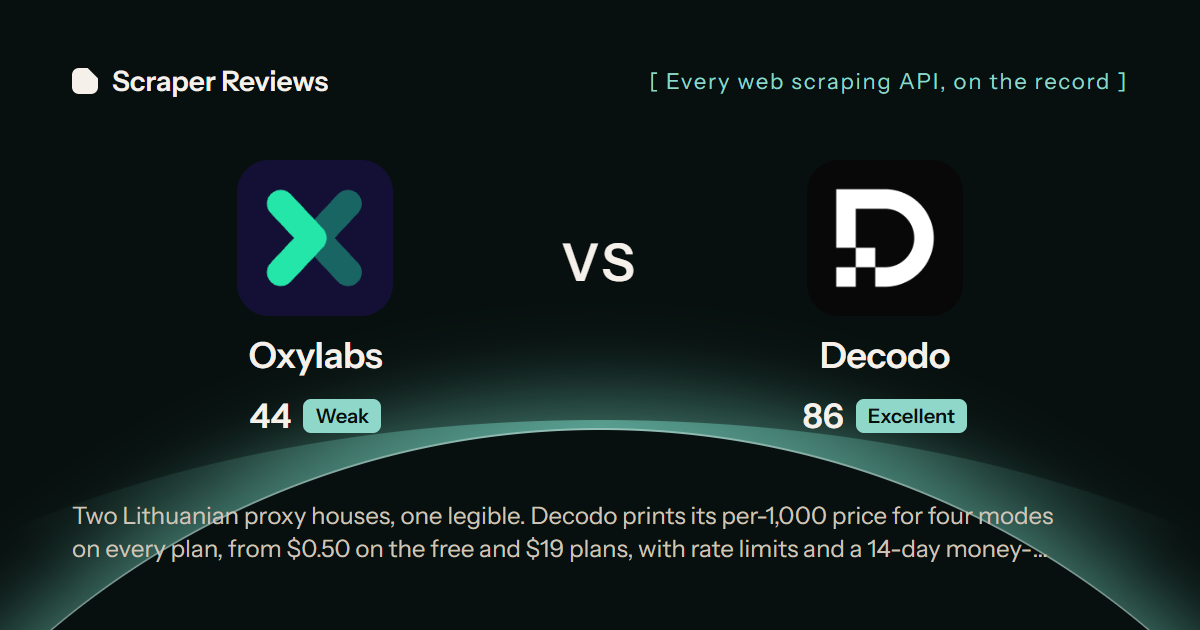
 OxylabsvsDecodo44 vs 86
Two Lithuanian proxy houses, one legible. Decodo prints its per-1,000 price for four modes on every plan, from $0.50 on the free and $19 plans, with rate limits and a 14-day money-back option; Oxylabs publishes two from-prices, $49 a month and $0.25 per 1,000 results, and its plan table returned 404 to our reader. Until Oxylabs' ladder can be quoted, Decodo is the one a buyer can size from the page.
Run a scraping API?Get it on the record.
Send us the pages that state your prices, credit costs and limits. We read them, score them on the public rubric, and publish the review with the date.